History
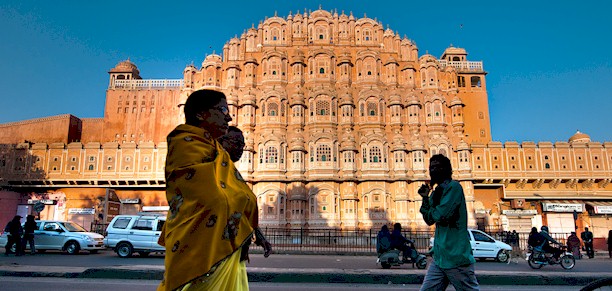

History of Rajasthan
The north-western region of India, which incorporates Rajasthan, remained in
early history for the most part independent from the great empires consolidating
their hold onthe subcontinent. Buddhism failed to make substantial inroads here;
the Mauryan Empire (321-184 BC), whose most renowned emperor Ashoka converted to
Buddhism in262 BC, had minimal impact in Rajasthan. However, there are Buddhist
caves and stupas (Buddhist shrines) at Jhalawar, in southern Rajasthan. Ancient
Hindu scriptural epics make reference to sites in present day Rajasthan. The
holy pilgrimage site of Pushkar is mentioned in both the Mahabharata and Ramayma.
The fall of the Gupta Empire, which held dominance in northern India for nearly
300 years, until the early 5th century, was followed by a period of instability
as various local chieftains sought to gain supremacy. Various powers rose and
fell in northern India. Stability was only restored with the emergence of the
Gurjara Pratihar as, the earliest of the Rajput (from 'Rajputra', or Sons of
Princes) dynasties which were later to hold the balance of power throughout
Rajasthan. The emergence of the Rajput warrior clans in the 6th and 7th
centuries played the greatest role in the subsequent history of Rajasthan. From
these clans emerged the name Rajputana, by which the collection of princely
states came to be known during the Muslim invasion of India. The Sisodias of the
Suryavansa Race, originally from Gujarat, migrated to Rajas-than in the mid-7th
century and reigned over Mewar, which encompassed Udaipur and Chittorgarh.The
Kachhwa has, originally from Gwalior in Madhya Pradesh, travelled west in
the12th century. They built the massive fortress at Amber, the capital later
being shifted to Jaipur. Like the Sisodias, they belonged to the Suryavansa
Race. Also belonging to the Suryavansa Race, the Rathores (earlier known as
Rastrakutas) travelled from Kanauj, in Uttar Pradesh. Initially they settled in
Pali, south of present-day Jodhpur, but later moved to Mandore in1381 and ruled
over Marwar (Jodhpur). Later they commenced construction on the stunning
Meherangarh Fort at Jodhpur. The Bhattis, who belong to the Induvansa Race,
driven from their homeland in the Punjab by the Turks, installed themselves at
Jaisalmer in 1156. They remained more or less entrenched in their desert kingdom
until they were integrated into the state of Rajasthan following Independence.
The first external threat to the dominance of the Rajputs was that posed by the
Arabs who took over Sind in 713. The Gurjara Pratiharas' response to the Arab
threat was largely defensive. The Arabs were repulsed by the Gurjara Pratiharas
led by their king, Nagabhata I, founder of the Pratihara Empire. The Arabs also
tested their strength against the Rastrakut as. Unfortunately, when not pitting
their wits against the Arabs, the Pratiharas and Rastrakut as were busy fighting
each other. By the third decade of the 8th century, anew threat was emerging in
the form of the Turks, who had occupied Ghazni in Afghanistan. Around 1001 AD,
Mahmud of Ghazni's army descended upon India, destroying infidel temples and
carrying off everything of value that could be moved. The Rajputs were not
immune from these incursions; a confederation of Rajput rulers assembled a vast
army and marched northwards to meet the advancing Turks. Unfortunately,
how-ever, it was a case of too little, too late, and they were decisively and
crushingly vanquished. The Pratiharas, then centred at Kanauj, fled the city
before the Turks arrived, and in their absence the temples of Kanauj, as with so
many others in northern India, were sacked and desecrated, Towards the end of
the 12th century, Mohammed of Ghori invaded India to take up where Mahmud of
Ghazni had left off. Hemet with a collection of princely states which failed to
mount a united front. Although initially repulsed, Ghori later triumphed, and
Delhi and Ajmer were lost to the Muslims. Ajmer remained a Muslim stronghold
over the centuries, apart from a brief period when it was retaken by the
Rathores. Today it is an important Muslim place of pilgrimage.
Mohammed of Ghori was killed in 1206, and his successor, Qutb-ud-din, became the
first of the Sultans of Delhi. Within 20 years, the Muslims had brought the
whole of the Ganges basin under their control. In 1297, Ala-ud-din Khilji pushed
the Muslim borders south into Gujarat. Ala-ud-din mounted a protracted siege of
the massive fort at Ranthambhore, which was at the time ruled by the Rajput
chief Hammir Deva. Hammir was reported as dead (although it's unknown if he did
actually die in the siege) and upon hearing of their chief's demise, the
womenfolk of the fortress collectively threw themselves on a pyre, thus
performing the first instance of jauhar, or collective sacrifice, in the history
of the Rajputs. Alu-ud-din later went on to sack the fortress at Chittorgarh in
1303, held by the Sisodia clan. According to tradition, Alu-ud-din had heard
repute of the great beauty of Padmini, the consort of the Sisodian chief, and
resolved to carry her off with him. Like Ranthambhore before it, Chittorgarh
also fell to the Muslim leader.
The Delhi sultanate weakened at the beginning of the 16th century, and the
Rajputs took advantage of this to restore and expand their territories. At this
time the kingdom of Mewar, ruled by the Sisodias under the leadership of Rana
Sangram Singh, gained preeminence among the Rajput states. Under this leader,
Mewar pushed its boundaries far beyond its original territory, posing a
formidable threat to the new Mughal Empire which was emerging under the
leadership of Babur (reigned 1527-30). Babur, a descendent of both Timur and
Genghis Khan, marched into Punjab from his capital at Kabul in Afghanistan in
1525and defeated the Sultan of Delhi at Panipat. He then focused his attention
on the Rajput princely states, many of whom, anticipating his designs, had
banded together to form a united front under Rana Sangram Singh. Unfortunately,
when the inevitable confrontation took place, the Rajputs were defeated by
Babur. They sustained great losses, with many Rajput chiefs falling in the fray,
including Rana Sangram Singh himself, who reputedly had no less than 80 wound
son his body suffered during both this and previous campaigns. The defeat shook
the very foundations of the princely states. Mewar's confidence was shattered by
the death of its illustrious leader, and its territories contracted following
sub-sequent attacks by the Sultan of Gujarat, At this time Marwar, under its
ruler Maldeo, emerged as the strongest of the Rajput states, and it recorded a
victory against the claimant to the Mughal throne, Sher Shah. However, none of
the Rajputs was able to withstand the formidable threat posed by the most
renowned of the Mughal emperors, Akbar (reigned 1556-1605).Recognising that the
Rajputs could not be conquered by mere force alone, Akbar contracted a marriage
alliance with a princess of the important Kachhwaha clan who held Amber (and
later founded Jaipur). The Kachhwahas, unlike their other Rajputbrethren at the
time, aligned themselves with the powerful Mughals, and even sent troops to aid
them in times of battle. Akbar also used more conventional methods to assert,
his dominance over the Rajputs, wresting Ajmer from the Rathores of Marwar which
had been briefly restored to the Rajputs under Maldeo. All the import-ant Rajput
states eventually acknowledged Mughal sovereignty and became vassal states of
the Mughal Empire, except Mewar, which fiercely clung to its independence,
refusing to pay homage to the infidels. An uneasy truce was thus maintained
between the Rajputs and the Mughal emperors, until the reign of Aurangzeb, the
last great Mughal emperor, when relations were characterized by mutual
hostility. Aurangzeb devoted his resources to extending the empire's boundaries.
The punitive taxes which he levied on his subjects to pay for his military
exploits and his religious zealotry eventually secured his downfall. The Rajputs
were united in their opposition to Aurangzeb, and the Rathores and Sisodias
raised arms against him. It didn't take long for revolts by the enemies of
Aurangzeb to break out on all sides and, with his death in 1707, the Mughal
Empire's for-tunes rapidly declined.
Following the death of Aurangzeb and the dissolution of the Mughal Empire came
the Marathas. They first rose to prominence with Shivaji who, between 1646 and
1680, per-formed feats of arms and heroism across central India. The Maratha
Empire continued under the Peshwas, hereditary government ministers who became
the real rulers. They gradually took over more and more of the weakening Mughal
Empire's powers, first by supplying troops and then by actually taking control
of Mughal land. The Marathas conducted numerous raids on the Rajputs, and the
latter, too busy fighting among themselves, laid themselves wide open to these
aggressions, resulting in numerous defeats in battle, the loss of territories
and the invitable decline of the rajput states.
In the early 19th century, the East India Company, a London trading company
which had a monopoly on trade in India, was taken over by the British
Government, and India was effectively under British control. Meanwhile, the
Marathas continued to mount raids on the Rajputs. Initially the British adopted
a policy of neutrality towards the feuding parties. However, the British
eventually stepped into the fray, negotiating treaties with the leaders of the
main Rajput states. British protection was offered in return for Rajput support.
Weakened by habitual fighting between themselves and in their skirmishes with
the Marathas, one by one the princely states forfeited their independence in
exchange for this protection. British residents were gradually installed in the
princely states. The British ultimately eliminated the Maratha threat, but by
this stage the Rajputs were effectively reduced to puppet leaders and lackeys of
the British. While the Rajput leaders enjoyed the status and prestige of their
positions, discontent was manifesting itself among numbers of their subjects,
which broke out in rebellion in 1857. This rebellion proved to be a precursor to
widespread opposition to British rule throughout India. It was Mohandas Gandhi,
later to be known as Mahatma Gandhi, who galvanised the peasants and villagers
into then on-violent resistance which was to spear-head the nationalist
movement. By the time WWII was concluded, Indian independence was inevitable.
The war dealt a deathblow to colonialism and the myth of European superiority,
and Britain no longer had the power nor the desire to maintain a vast empire.
Within India, however, a major problem had developed: the large Muslim minority
had realized that an independent India would also be a Hindu-dominated India.
The country was divided along purely religious lines, with the Muslim League,
led by Muhammad Ali Jinnah, speaking for the Muslims, and the Congress Party led
by Jawaharlal Nehru, representing the Hindu population. Gandhi was absolutely
opposed to the severing of the Muslim dominated regions from the prospective new
nation. However, Jinnah was intransigent: I` will have India divided, or India
destroyed,` was his uncompromising demand. The new viceroy, Louis Mountbatten,
made a last-ditch attempt to convince the rival factions that a united India was
a more sensible proposition, but the reluctant decision was made to divide the
country. Independence was finally instituted on 15 August 1947, with the
concomitant partitioning of the nascent country. The result was a
Hindu-dominated India and a Muslim-dominated West and East Pakistan.
Emergence of the State of Rajasthan "It took some time for the boundaries of the
proposed new state of Rajasthan to be defined. In 1948, Rajasthan comprised the
south and south-eastern states of Rajputana. With the merger of Mewar, Udaipur
became the capital of the United State of Rajasthan. The Maharana of Udaipur was
invested with the title of rajpramukh (head of state). Manikya Lal Varma was
appointed as prime minister of the new state, which was inaugurated on 18 April
1948.Almost from the outset the prime minister came into opposition with the
rajpramukh over the constitution of the state government ministry. Varma wanted
to form a ministry of all Congress members. The rajpramukh was keen to have his
own candidates installed from among the jagirdars, or feudal lords. Jagirdars
traditionally acted as intermediaries between the tillers of the soil (the
peasants) and the state, taking rent or produce from the tenants and paying
tribute to the princely ruler. They were symbols of the old feudal order, for
whom millions of inhabitants of Rajputana were held in serfdom. Varma was keen
to abolish the age-old system of jagirdari and, with Nehru's support, was able
to install his own Congress ministry and do away with this feudal relic. Still
retaining their independence from India were Jaipur and the desert kingdoms of
Bikaner, Jodhpur and Jaisalmer. From a security point of view, it was vital to
the new Indian Union to ensure that the desert kingdoms, which were contiguous
with Pakistan, were integrated into the new nation. The princes finally agreed
to sign the Instrument of Accession, and the kingdoms of Bikaner, Jodhpur,
Jaisalmer and Jaipur were merged in 1949. The Maharaja of Jaipur, Man SinghII,
was invested with the title of rajpramukh. Jaipur became the capital of the new
state of Rajasthan. Heera Lal Shastri was installed as the first premier of
Rajasthan. Later in 1949, the United State of Matsya,comprising the former
kingdoms of Bharatpur, Alwar, Karauli and Dholpur, was incorporated into
Rajasthan. As a consequence, Rajasthan became the second largest state m India,
exceeded in geographical area only by the central Indian state of Madhya
Pradesh. Rajasthan attained its current dimensions in November 1956 with the
additions of Ajmer-Merwara, Abu Rd and a part of Dilwara, originally part of the
princely kingdom of Sirohi which had been divided between Gujarat and Rajasthan.
The princes of the former kingdoms were constitutionally granted handsome
remuneration in the form of privy purses to assist them in the discharge of
their financial obligations (and to keep them in the style to which they had
become accustomed). In1970, Indira Gandhi (daughter of India's first prime
minister, Jawaharlal Nehru), who had come to power in 1966, commenced
under-takings to discontinue the privy purses, which were abolished in 1971.
Many of the former rulers of Rajasthan continue to use the title of maharaja for
social purposes. The only power this title holds today is as a status symbol.
Since the privy purse abolition, the princes have had to financially support
themselves. Some hastily sold valuable heirlooms and properties for literally
nothing, in a desperate attempt to pay bills. While a handful of princes
squandered their family fortunes, others refused to surrender their heritage,
and turned their hands to business, politics or other vocations. Many decided to
convert their palaces into hotels as a means of earning income. Some of these
palace-hotels have become prime tourist destinations in India, such as the Lake
Palace Hotel in Udaipur, the Rambagh Palace in Jaipur and the Umaid Bhawan
Palace in Jodhpur. The revenue earned from such hotels has enabled the maharajas
to maintain their properties, sustain time-honored family traditions and
continue to lead a comfortable lifestyle. However, not all palaces are on the
tourist circuit and cannot rely purely on tourism as a source of steady income.
Many palaces and forts are tucked away in remote parts of Rajasthan, and have
been reluctantly handed over to the government, because the owners were simply
unable to maintain them. Unfortunately, many of these rich vestiges of India's
royal past are poorly maintained.
|
RAJASTHAN
CITY GUIDE
Jaipur
Jodhpur
Jaisalmer
Udaipur
Bikaner
Ajmer
Mount Abu
Bharatpur ABOUT RAJASTHAN
The History
Folk Music and Dances
Shopping
Cuisines
Arts and Crafts
Maps
Faces of Rajasthan CAR
RENTAL & HIRE
Car and Taxi Rental for Jaipur
and Rajasthan GENERAL
INFORMATION
Rajasthan City Guide
Rajasthan Tour Packages
Rajasthan Information
Useful Phrases
Passport and Visas
What to Pack

New Delhi Tour
Rajasthan Historic tour 10 days
Mewari Tour with Agra 7 days
Classic Golden Triangle tour 7 days
Rajasthan Wildlife Safari tour 6 days
Rajasthan Real Adventure 16 days
Rajasthan Tour with Agra 15 days
Jaipur city tour with Pushkar 4 days
Rajasthan Desert tour 7 days
Classic Desert tour 11 days
Jaipur city tour 3 days
Jaipur Tour
Rajasthan Tiger tour 6 days
Romantic Rajasthan tour 10 days
Mughal Triangle tour 6 days
Cultural Rajasthan tour 15 days
Jaipur city tour with Pushkar 4 days
Jaipur city tour 3 days
Magic of Rajasthan tour 15 days
Agra Tour
Rajasthan Kings tour 9 days
Rajasthan Treasure tour 7 days
Rajasthan Travel tour 14 days
Magical Golden Triangle tour 6 days
Rajasthan Package tour 12 days
Ahmedabad Tour
Ancient Rajasthan tour 15 days
Colors of Rajasthan 11 days
Jodhpur Tour
Classic Desert tour 11 days
Magical Rajasthan tour 10 days
Udaipur Tour
Palace tours of Rajasthan 11 days
Forts of Rajasthan tour 11 days
|

